Learning Outcomes:
i. Define and differentiate between least count and resolution of measuring instruments.
ii. Explain the relationship between least count and precision of measurements.
iii. Identify the least count of common measuring instruments, such as rulers, vernier calipers, and micrometers.
iv. Understand the concept of error in measurements and its relation to least count.
Introduction:
In the world of scientific inquiry, precise and accurate measurements are fundamental to achieving reliable results. Measuring instruments play a crucial role in obtaining these measurements, but it is essential to understand their limitations. This lesson explores the concepts of least count and resolution, which are critical parameters that influence the precision of measurements.
i. Least Count:
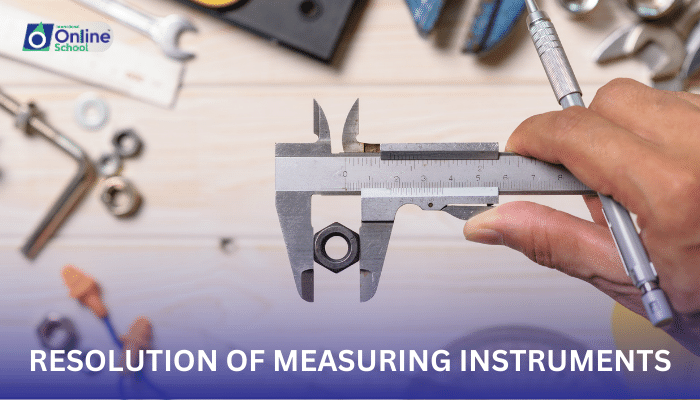
The least count of a measuring instrument is the smallest increment that can be reliably measured with that instrument. It represents the finest division on the instrument's scale. For instance, a ruler with millimeter markings has a least count of 1 millimeter, meaning it can measure lengths to the nearest millimeter. A vernier caliper, with finer markings, has a least count of 0.1 millimeter, allowing for measurements with greater precision.
ii. Resolution:
Resolution refers to the ability of a measuring instrument to distinguish between small differences in measurements. It is the smallest change in a quantity that an instrument can detect. In simpler terms, resolution is the measure of how close two measurements can be before they appear the same to the observer.
iii. Relationship between Least Count and Precision:
Least count and precision are closely linked concepts. Precision, in the context of measurements, refers to the degree of consistency or reproducibility of measurements. A measuring instrument with a smaller least count is generally considered to be more precise, as it can achieve finer distinctions between measurements.
Examples of Least Count:
- Ruler: 1 millimeter (mm)
- Vernier Caliper: 0.1 millimeter (mm)
- Micrometer: 0.01 millimeter (mm) or 10 micrometers (µm)
iv. Error in Measurements:
No measurement is perfect, and all measurements are subject to some degree of error. Error is the difference between the true value of a quantity and the measured value. Least count plays a role in determining the error in a measurement. The error in a measurement is always greater than or equal to the least count of the instrument used.
Least count and resolution are essential concepts in understanding the capabilities and limitations of measuring instruments. By comprehending these concepts, we can make informed decisions about the selection and use of appropriate instruments for different measurement tasks. Moreover, understanding the relationship between least count and error allows us to make more accurate and reliable measurements.
